

Energy is still the Houston market. The work inside that label has changed. Data-centre load, transmission build-out and renewables are now sitting on the same desks as oil and gas, and the partner market is moving accordingly.
Where the work is
Three factors are driving partner demand in Houston right now.
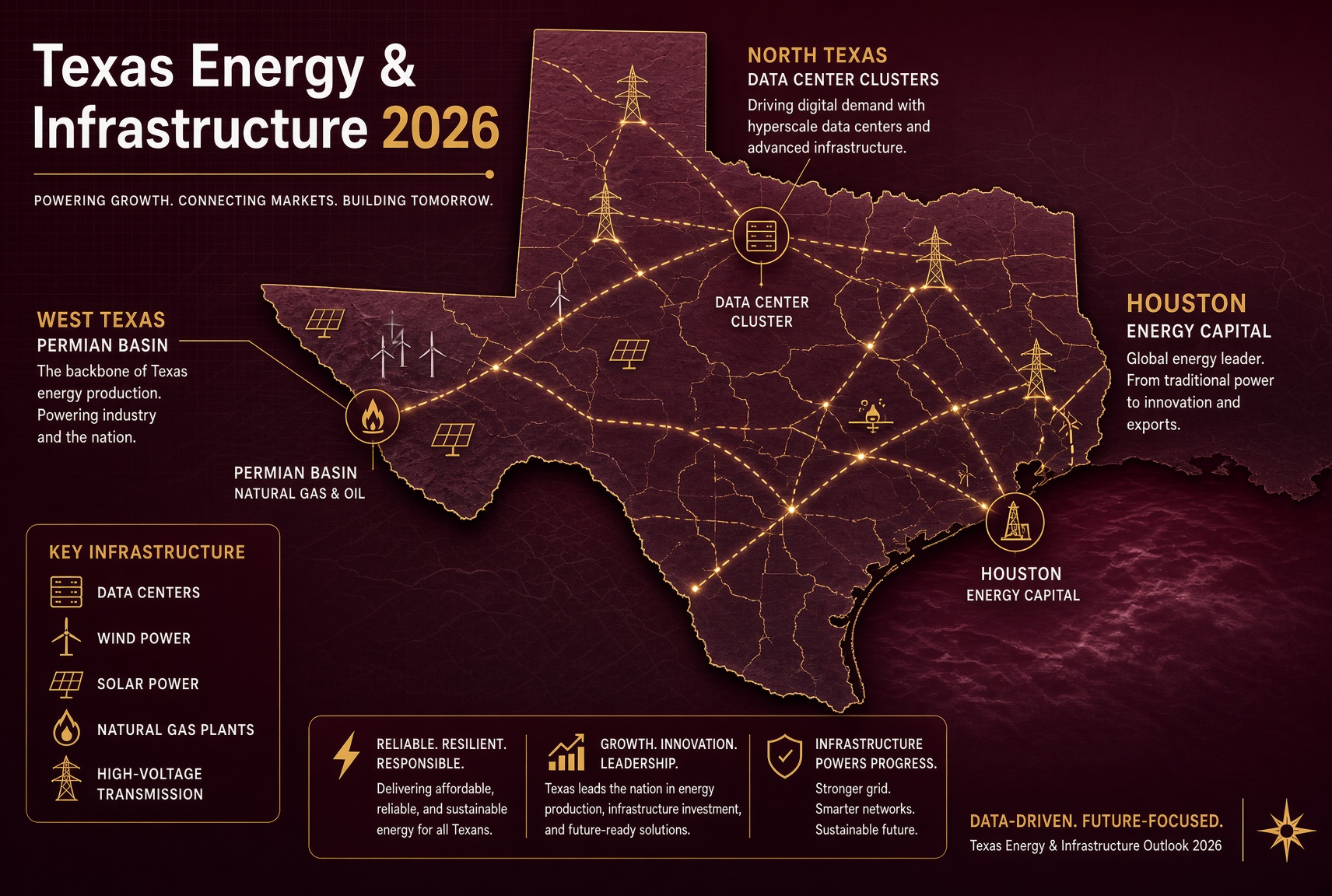
Data centres and large load.
Hyperscale and multi-gigawatt campuses are stacking interconnection requests on ERCOT. The commercial work is PPAs, co-located gas, “bring your own power”, site control and financing. The regulatory work is Batch Zero classification, cost allocation and delay risk after the state’s tighter review of large-load projects. Firms with long-standing utility clients are hitting conflict problems on the developer side. That is not theoretical. It is slowing some pitches and pushing work to firms that built walls early, or that never acted for Oncor, CenterPoint or TNMP.
Transmission and infrastructure.
The first 765-kV Permian segments are through the PUCT. They sit inside a much larger statewide build. That produces CCN work, landowner litigation, construction contracting and financing. It also produces political noise. Counsel who can run a contested case and close a development file are scarce.
Renewables and storage.
Texas is still adding solar and wind at scale. Federal credit timing is forcing projects to close rather than drift. That keeps tax equity, offtake and construction counsel busy, often on the same teams covering data-centre power.
The point for hiring: firms are not looking for a “data centre lawyer” in the abstract. They want energy project, regulatory or PE/M&A partners who have already touched large load, generation or digital infrastructure. Pure oil and gas partners without that adjacency are harder to place at the top of the market than they were two years ago.
What the partner market is doing
Headcount growth is concentrated at the top. National and Magic Circle platforms are adding in Texas faster than the broader Am Law pack. That matches what we are seeing on live searches: Houston energy/infrastructure partner mandates are open, compensation is custom, and lock-ups are being used. Partners who are well paid, busy and not overworked are not moving unless the platform is clearly better for the next five years of power and infrastructure work.
Kirkland now has the largest Texas headcount and continues to take energy and infrastructure teams. Foley is building a Texas energy and infrastructure bench in public increments. Mayer Brown has been explicit about a Houston surge off the McGuireWoods talent. Willkie is using deal flow and targeted infra hires to reset its Texas story. Baker Botts is promoting from inside the energy/infrastructure/technology overlap rather than only buying names.
Conflicts and culture still decide outcomes. A partner with a portable developer book will not walk into a firm that is first-chair to a major TDU without a waiver conversation on day one. Several Texas firms are now asking for advanced waivers as standard on digital infrastructure.
Laterals that actually tell you something
These are public moves. They matter because of the practice, not the press release.
- Stephen Olson, Gibson Dunn → Foley & Lardner (Houston), September 2026. PE and energy/infrastructure transactions. Foley’s fourth Texas energy and infrastructure partner hire this year. Read it as Foley paying to stay in the private-capital plus energy conversation, not as a one-off.
- Baker Botts leadership appointments, September 2026. Four partners in energy, infrastructure and technology moved into internal leadership. That is a client-facing signal: the firm is organising around the same intersection clients are funding.
- Fern Han, Simpson Thacher → Kirkland & Ellis (Houston), August 2026. Project finance, energy and infrastructure. Classic Kirkland add: finance talent that can sit on large energy/infra files.
- Matthew Penny, Jackson Walker → Willkie (Houston/Dallas), August 2026. Development and construction of energy and infrastructure, including data centres. This is the profile firms say they cannot find enough of: contracting and construction, not only M&A.
- Edmund Daniels, McGuireWoods → Mayer Brown (Houston), June 2026. Power, energy, infrastructure and data-centre transactions. Follows Mayer Brown’s earlier McGuireWoods group hire. Pattern, not isolated raid.
- David Aaronson, O’Melveny → McGuireWoods (Houston), June 2026. Energy M&A and finance. Replacement hire after Daniels left. The Houston energy bench is circulating, not only draining one way.
- Latham energy and infrastructure team led by Chris Peponis → Kirkland (Houston), March 2026. Team move. These still move the market more than single-partner announcements.
Also watch in-house to firm traffic. Project counsel leaving developers and IPPs (Pattern-type profiles into Skadden and peers) is a tell that private practice still pays for people who have closed real projects, not just advised on them.
What we would tell a firm or a candidate
Firms.If the mandate is “we need a data centre partner,” tighten it. Decide whether you need regulatory (PUCT/ERCOT), development/EPC, project finance, or PE/M&A with energy assets. The people who can do all four do not exist in volume, and the ones who can do two are already being paid. Utility conflicts need to be mapped before the first approach. Candidates will ask.
Partners.The movable profiles in Houston this year are project development/construction, power/regulatory with large-load experience, and PE/M&A partners who already act for sponsors in energy and infrastructure. A strong upstream-only book still has a home. It is not where most of the new platforms are spending.
Associates and counsel. Three to six years in energy projects, finance or regulatory is getting pulled early. Firms will train on data-centre specifics if the underlying project skill is there. They will not invent a projects practice around a generalist corporate associate.
Compensation is not the whole story, but it has moved. National firms are using non-lockstep packages and guarantees in Houston. Homegrown firms are competing on work quality, client access and the fact that the best energy files still often start in Houston, not New York.
2026–27
Two execution risks sit under the hiring story. First, generation and transmission will not arrive on the same timetable as announced load. That creates disputes, renegotiations and aborted developments work, but not the same work as a clean project finance close. Second, political and regulatory friction around data centres can freeze a file for a quarter and then restart it. Firms that staffed only for a straight-line boom will feel that.